
In Alberta, many roofs are replaced earlier than homeowners expect because hail, UV exposure, and freeze-thaw cycles. Roof shingles lose performance as their natural oils evaporate - making them dry out, stiffen, and lose their flexibility. They become brittle, and in Alberta that process is particularly bad due to our beautiful summers, and tough winters.
Which is why we created Bright Green Roof. Our patented oil is designed to absorb into asphalt shingles, restoring the lost natural oils, and increasing their lifespan. Its an environmentally friendly way to save money, and protect your home. But how does it work? Lets take a look!
The Science of Roof Rejuvenation
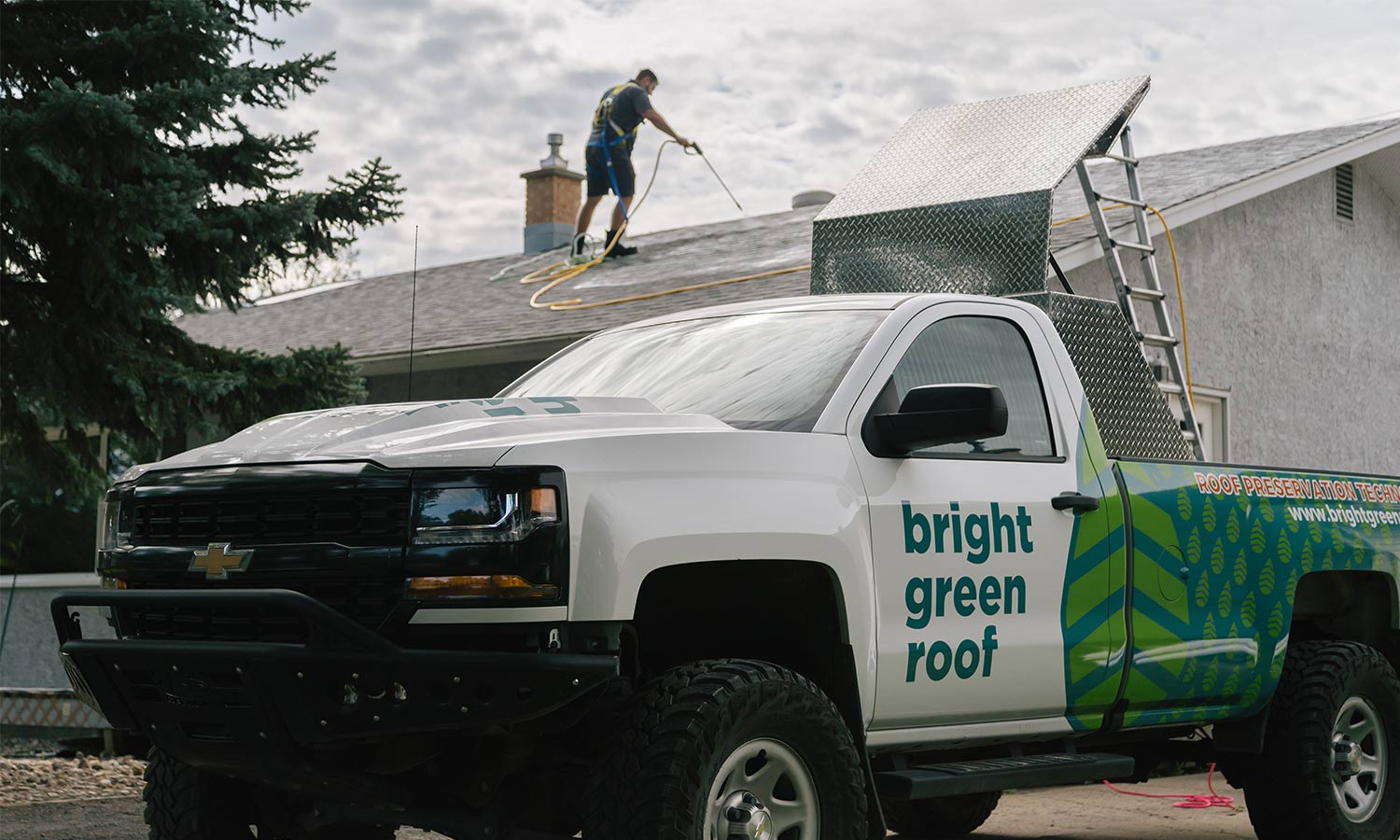
Most roofs do not “suddenly fail.” They slowly lose performance as the shingles dry out, stiffen, and lose their flexibility. In Alberta that process is particularly bad due to our beautiful summers, and tough winters. Our formula is designed to penetrate your shingles and restore those lost oils. Its an environmentally friendly way to save money, and protect your home.
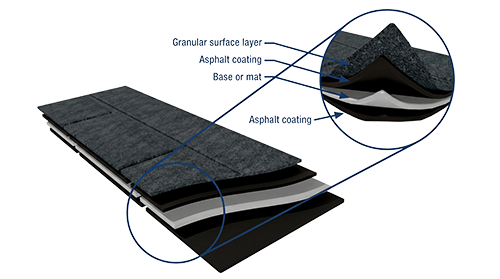
What is a shingle?
Asphalt shingles are not just “tar and rocks.” They are a layered composite designed to shed water, block UV, and resist wind uplift.
A typical asphalt shingle system includes:
- Fiberglass mat: the structural backbone that gives the shingle strength.
- Asphalt Mat: waterproofing layer which provides flexibility while healthy.
- Mineral granules: the gritty top layer that protects the asphalt from UV and adds abrasion resistance.
- Seal strip: an adhesive band that bonds shingles together after installation to resist wind lift.
When shingles age, it is usually not because the fiberglass mat suddenly gives up. It is because the asphalt layer loses bitumen over time (the natural oils evaporate) and the shingles become brittle - cracking, curling and vulnerable to damage like hail.
Oxidation and “Drying Out”
Think of shingles like a flexible waterproof skin. When that skin is healthy, it bends and rebounds. When it dries out, it becomes stiff and brittle.
Two processes drive most shingle aging:
Oxidation
Over time, oxygen and UV exposure cause the asphalt to oxidize. Oxidized asphalt becomes harder and less elastic.
Loss of lighter components
As shingles weather, the asphalt slowly loses some of the compounds that help it stay pliable.
A brittle shingle has less ability to absorb stress. That matters here because Alberta stresses roofs constantly:
- Wind events lift and flex tabs. Brittle tabs crack or tear more easily.
- Hail impacts concentrate force at a point. Brittle shingles crack instead of deforming and recovering.
- Freeze-thaw cycling expands moisture in tiny gaps. Brittle shingles are more likely to develop micro-cracks that grow season after season.
- Daily heat cycling (cool nights, warmer afternoons) causes repeated expansion and contraction, which fatigues stiff materials faster.
This is why two roofs of the same age can perform very differently. The hidden variable is often how much flexibility the shingles have left.
3) What shingle preservation is designed to do
Shingle preservation is a materials strategy. The goal is to improve the way the shingle behaves today and slow down how fast it degrades going forward.
At a high level, the treatment is intended to:
- Recondition the asphalt layer so it remains more flexible
- Reduce brittleness, which helps shingles handle movement and impact better
- Support better system performance, especially in wind and storms, because flexible shingles are less likely to crack or tear under stress
- Help you delay replacement, which is often the biggest financial win
This is not about pretending an old roof is new. It is about extending the useful life of a roof that still has solid structure and shingles that are still worth saving.
4) Why flexibility is such a big deal (and how we tested it)
If you want one “science word” that matters for shingle preservation, it is pliability.
Pliability is basically the shingle’s ability to bend without cracking. The more pliable the shingle, the better it can tolerate:
- Wind lift and flutter
- Thermal expansion and contraction
- Minor impacts and vibrations
- Movement at edges, ridges, and transitions
Our pliability results
Bright Green Roof submitted shingles for third-party testing using ASTM International methods, including a pliability test where samples are conditioned to different temperatures and bent around a specified rod to check for cracking.
In our results, both the top and bottom samples passed across all test runs, and achieved a final “Yes” pass rating. Practically speaking, this supports what we care about in Alberta: shingles that keep their ability to move and flex instead of turning into something that snaps under stress.
What that means for a homeowner: if your roof still qualifies, improving pliability can help the roof tolerate wind events and seasonal movement with less risk of brittle cracking.
5) Granules are not cosmetic. They are your UV shield
Those little mineral granules on top of your shingles are doing serious work. They:
- Block UV from hitting the asphalt directly
- Protect the shingle surface from abrasion
- Help regulate surface temperature (to a degree)
When granules loosen and shed, the shingle is more exposed. Exposed asphalt ages faster, dries out faster, and becomes brittle faster. It is a feedback loop.
Our granule adhesion results
Bright Green Roof also tested granule adhesion using ASTM methods (including mechanical abrasion). In our reporting, one sample was brushed 30 times and the measured granule loss recorded was 0.09 grams.
For homeowners, the takeaway is simple: granule bond matters because it affects how fast shingles weather in the sun. Better adhesion supports long-term durability and UV resistance.
6) Absorption and spread: why application behavior matters
Homeowners often ask, “How does a treatment actually work if it just sits on top?” It is a fair question, and it is exactly why absorption matters.
If the treatment does not absorb and spread appropriately, you do not get consistent conditioning across the shingle. That means uneven results.
Our absorption observations
We performed absorption testing to see how the product spreads after application and how treated shingles behave over time (including early and longer exposure windows). In plain English, we want the treatment to move through the surface effectively so the conditioning effect is not just spotty or superficial.
What this means for your roof: consistent absorption and spread supports consistent performance, especially on large roof planes where sun exposure is intense and uniformity matters.
7) Fire performance: what our flame testing showed
Another question we hear is whether an oil-based treatment increases fire risk. That is the right question to ask.
In our flame testing observations:
- The treated samples showed minor degradation beyond a five-minute mark during exposure.
- Any flames that appeared on the treated samples promptly vanished once the flame source was removed.
- The untreated sample ignited instantly, then succumbed to heat and melted and broke down.
In our summary of results, the treatment was noted as improving the fire rating by 40%.
What this means for homeowners: the treated shingles demonstrated better behavior under flame exposure in our observed testing, which is the outcome you want when thinking about overall roof safety.
8) Compliance and safety positioning
Bright Green Roof’s shingle preservation oil is positioned as compliant with both United States Department of Agriculture and United States Environmental Protection Agency requirements, which matters for homeowners who care about what gets applied to their home and what ends up around landscaping, pets, and kids.
We built Bright Green Roof around the idea that homeowners should not have to choose between performance and peace of mind.
9) What shingle preservation can and cannot do
This is where the “expert advice” part matters most, because the industry gets confusing fast.
What it can do (when the roof qualifies)
- Help shingles stay flexible longer
- Slow down weathering driven by sun and oxidation
- Improve how the roof tolerates wind and seasonal movement
- Help reduce brittle-related cracking risk
- Delay replacement so you can plan the big expense on your terms
What it cannot do
- It will not fix rotten or soft decking
- It will not solve an active leak caused by flashing failures or structural issues
- It will not resurrect shingles that are already heavily cracked, badly curled, or falling apart
- It will not turn a worn-out roof into a brand-new roof
The best outcomes happen when preservation is done on a roof that still has real life left.
10) The “do I qualify?” reality check
If you want the simplest rule: preserve roofs that are aging, not failing.
A roof is usually a good candidate when:
- Shingles are mostly flat and intact
- No active leaks
- The roof deck feels solid
- The roof is in the “middle years” and showing normal aging signs
- The main issue is drying and loss of resilience, not major failure
A roof is usually not a candidate when:
- You have recurring or active leaks
- Shingles are cracking widely across multiple slopes
- You see heavy curling, splitting, or missing sections
- The roof structure is compromised
When we inspect a roof, we are making sure that our treatment is right for your roof - our product is preventative maintenance, and we want to make sure its the right choice for every customer. If preservation is a smart investment, we will tell you. And if not? We will let you know, and why. Plus our expert roofing team will make the recommendations you need to keep your roof healthy - even if we aren't the service provider that works for you.

In Alberta, roof replacement is the right move when your roof is failing. Shingle preservation is the smart move when your roof is still healthy enough to save and you want to slow down aging before it turns into costly damage. If you want help deciding, Bright Green Roof can inspect your roof and give you a clear recommendation. Either way, you will walk away knowing exactly where you stand and what your best next step is.
How Shingle Preservation Extends Roof Life (and Why It Works)
Shingles don’t fail because they’re “old.” They fail because they dry out.
As shingles age, the oils inside them evaporate and oxidize. The shingles will crack, curl and eventually go bust.
Shingle preservation works by replenishing those lost oils using a 100% plant-based treatment that penetrates deep into the asphalt and restores flexibility.
Think of it like moisturizing your roof — except with natural bio-oils specifically designed to bond to asphalt molecules. Its a simple treatment which can save you a lot of headache!
Get Your Free quoteAs shingles age, the oils inside them evaporate and oxidize. The shingles will crack, curl and eventually go bust.
Shingle preservation works by replenishing those lost oils using a 100% plant-based treatment that penetrates deep into the asphalt and restores flexibility.
Think of it like moisturizing your roof — except with natural bio-oils specifically designed to bond to asphalt molecules. Its a simple treatment which can save you a lot of headache!
 Backed by Science
- Proven ASTM Testing
- Guaranteed for 5 years
- USDA-certified plant-based formula
- Made In Alberta, For Alberta