
Why Are My Roof Shingles Losing Granules?
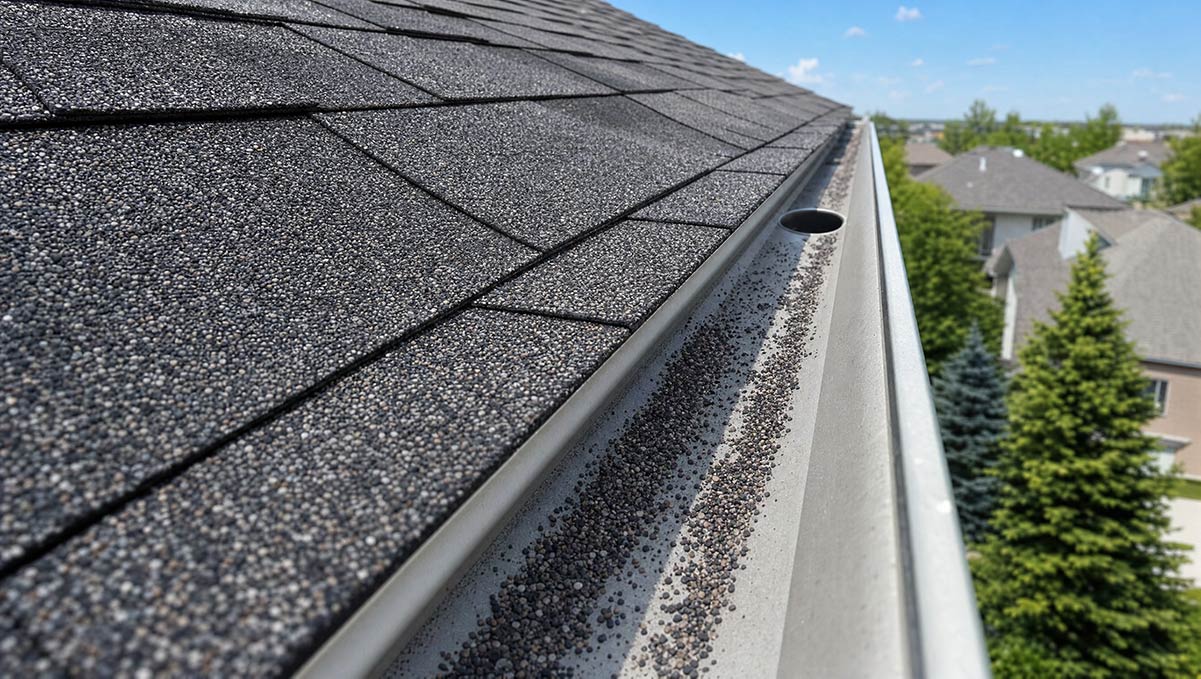
Finding gritty material in your gutters can look alarming, but some granule loss is normal. The important part is understanding how much you're losing, why it's happening, and what the shingles underneath look like.
Asphalt shingles naturally shed some mineral granules throughout their life. New roofs may lose loose excess granules, while older roofs can lose more as the asphalt weathers. The concern increases when large areas become bare, loss accelerates suddenly, or it appears alongside cracking, curling, hail impacts or leaks.
What Do Roof Granules Actually Do?
An asphalt shingle isn't simply a flat sheet of black asphalt.
Modern shingles typically use a fiberglass mat coated with asphalt and covered by mineral granules on the exposed surface.
Those granules are an important part of the roofing system.
UV Protection
The granules shield the asphalt underneath from direct ultraviolet exposure and weathering.
Surface Protection
They provide the durable outer surface exposed to Alberta's sun, rain, wind, snow and storms.
Colour & Function
Granules create the visible roof colour and may also provide specialized properties depending on the shingle.
Is Some Shingle Granule Loss Normal?
Yes.
Seeing a small amount of granule loss does not automatically mean your roof is failing.
Manufacturers intentionally apply more granules during production than ultimately remain embedded in the asphalt.
Loose excess granules can work free during handling, installation and the first years of weather exposure before eventually washing into gutters and downspouts.
What Does Increasing Granule Loss Look Like?
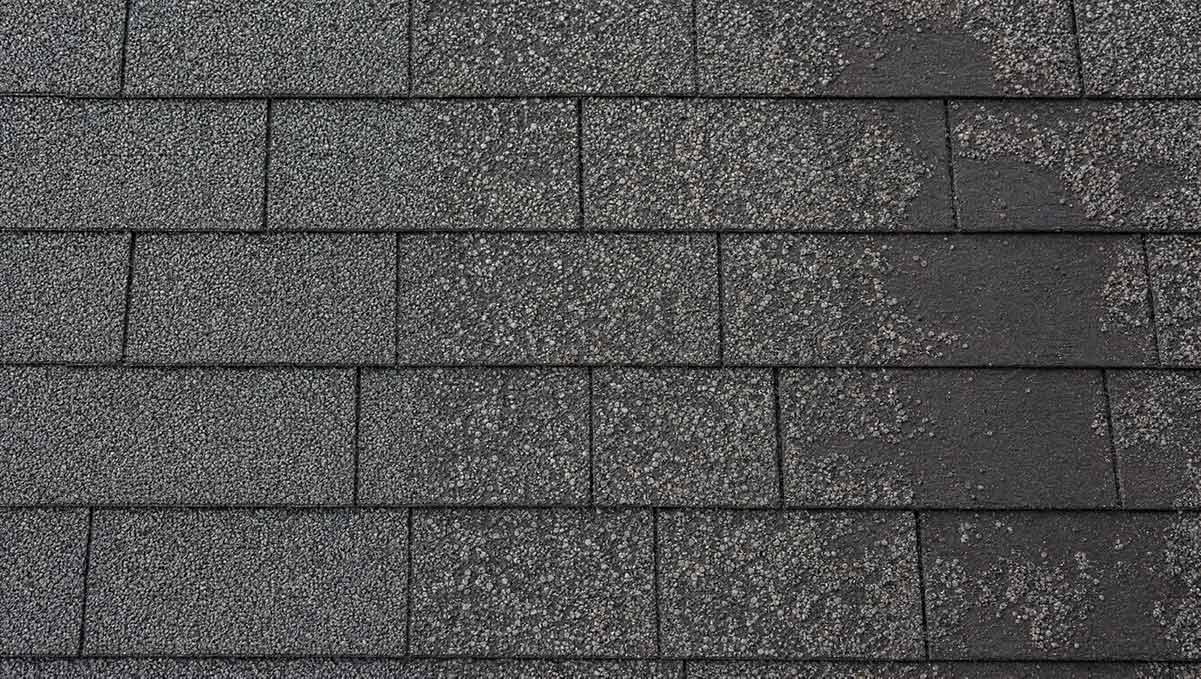
Granule loss becomes more useful diagnostically when you look at the amount of asphalt that remains protected underneath.
Why Is My New Roof Losing Granules?
If the roof was installed recently and you're already finding granules in the gutter, that does not necessarily mean something went wrong.
Loose granules can result from manufacturing, packaging, transportation, handling and cutting during installation.
Rain then carries those particles down the roof and into the eavestrough.
The amount should generally become less noticeable as the roof settles in.
What deserves more attention is heavy or continuing loss that creates clearly exposed areas of asphalt.
Why Older Asphalt Shingles Lose Granules
Granule loss becomes more meaningful as a roof ages.
Asphalt shingles spend years exposed to sunlight, heat, moisture, freezing temperatures and seasonal weather changes.
As the asphalt around the granules ages, the bond holding those granules in place can gradually weaken.
Rain and wind then remove more of them over time.
On an aging roof, you may begin noticing:
- More granules around downspout outlets
- Areas of the roof looking smoother
- Uneven colour across the shingles
- Darker asphalt becoming visible
- Granule loss appearing alongside fading or brittleness
At this stage, granule loss is best treated as one clue in the overall condition of the roof rather than a diagnosis by itself.
Can Hail Cause Granule Loss?
Absolutely, and this is particularly relevant in Alberta.
When hail hits an asphalt shingle, the impact can knock mineral granules away from the surface.
More significant impacts may also bruise or damage the asphalt and fiberglass structure underneath.
The pattern often looks different from gradual age-related weathering.
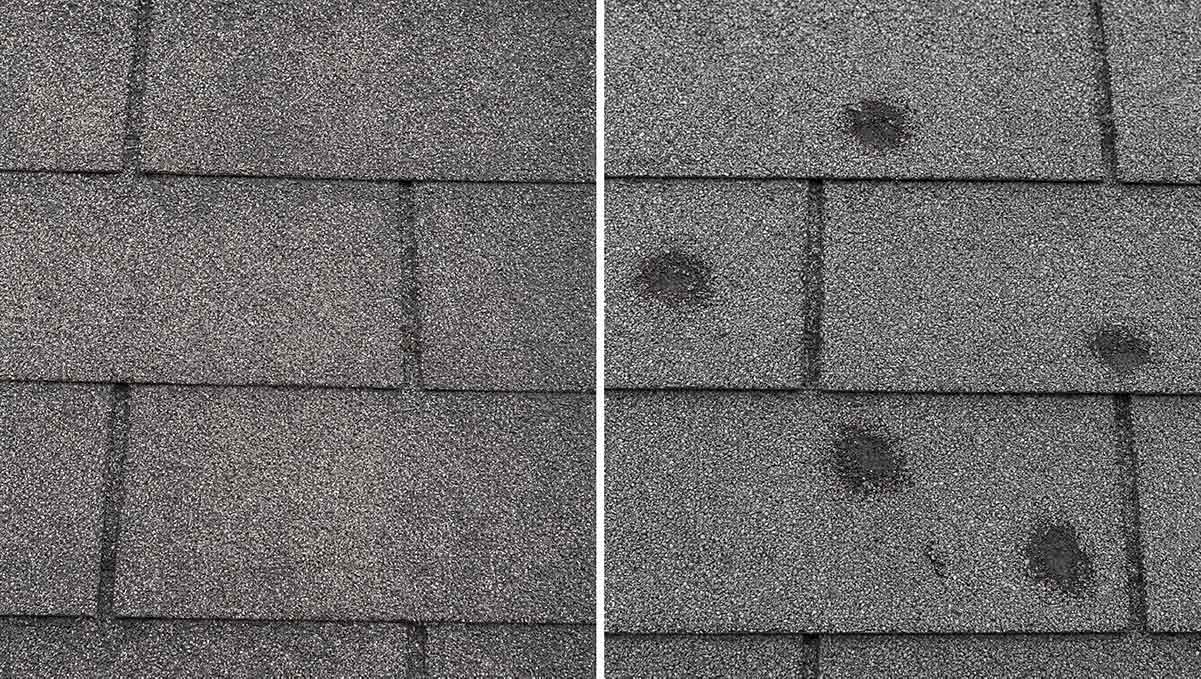
After a significant storm, signs worth looking for include:
- Small dark impact areas
- Localized spots where granules are suddenly missing
- Dents on metal vents, gutters or flashing
- Damage concentrated on particular roof slopes
- A sudden increase in loose granules after the storm
Other Things Can Knock Granules Off Too
Not every case of granule loss is caused by age or hail.
Mechanical contact can physically dislodge granules from the asphalt surface.
Why Are There So Many Granules in My Gutters?
Your gutter is simply where loose granules naturally collect.
Rainwater carries them toward the bottom edge of the roof and into the eavestrough.
The amount and timing tell you more than their mere presence.
Small Amount on a New Roof
These may simply be loose excess granules left from manufacturing and installation.
Gradual Increase on an Older Roof
This can reflect age-related weathering and weakening granule adhesion.
Sudden Increase After Hail
A storm may have physically displaced granules or damaged shingles.
Heavy Loss + Bare Roof Areas
Visible exposed asphalt indicates that part of the protective granule surface has been lost.
How Can I Inspect Granule Loss Safely?
You do not need to climb onto your roof to identify the most useful warning signs.
In fact, unnecessary roof walking creates both a fall risk and the possibility of damaging shingles further.
A pair of binoculars and a good view from the ground can tell you a surprising amount.
When Is Granule Loss Minor — And When Is It a Problem?
Usually Less Concerning
- The roof is relatively new
- Only small quantities are appearing
- The amount is decreasing over time
- The roof still looks evenly covered
- No asphalt is clearly exposed
- No cracks, curling or missing shingles
- No recent major hail event
Worth a Professional Look
- Large areas of asphalt are exposed
- Loss is increasing quickly
- Shingles are cracking or becoming brittle
- There is widespread curling or cupping
- Impact marks appeared after hail
- Shingles are missing or loose
- There are leaks or moisture damage
Can Roof Rejuvenation Help With Granule Loss?
Sometimes, but the distinction here matters.
Roof rejuvenation does not recreate mineral granules that have already been physically removed from the roof.
Where preservation may become relevant is earlier in the aging process, while the shingles remain structurally sound and still retain sufficient granule coverage.
Bright Green Roof's published testing includes granule-adhesion testing as well as testing related to shingle pliability and absorption.
Age-related deterioration in qualifying asphalt shingles that remain structurally sound.
Replace missing granules, rebuild damaged shingles, fix rotten decking or reverse significant hail damage.
When Are Repairs or Replacement More Appropriate?
Roof preservation is maintenance. It should not be used as a substitute for repairing a roofing system that has already failed.
Individual damaged shingles can sometimes be replaced while the rest of the roof remains serviceable.
More extensive work may be appropriate when there is:
- Widespread exposed asphalt
- Severe or extensive hail damage
- Large areas of cracked shingles
- Significant missing roofing material
- Active leaks
- Compromised flashing or penetrations
- Rotten or damaged decking
- Broad structural deterioration
It is to preserve roofs that still have useful service life remaining, and repair or replace the ones that do not.
What Should a Professional Roof Assessment Document?
If granule loss is concerning enough to have the roof inspected, you should come away with considerably more information than:
Granule Coverage
Are granules still evenly distributed, or are meaningful areas of asphalt exposed?
Distribution of Loss
Is wear uniform, isolated to one slope or concentrated around impact points?
Storm Damage
Are there bruises, cracks, dents or other signs of sudden physical damage?
Shingle Condition
Are shingles still intact and flexible, or are they cracking, curling and becoming brittle?
Repairs
Are only a few shingles damaged while the rest of the roof remains serviceable?
Overall Suitability
Can the roof reasonably be maintained or preserved, or is repair or replacement the responsible option?
Find Out What the Granule Loss Actually Means
A little shedding may be normal. An aging but structurally sound roof may still have preservation options. Hail damage or widespread deterioration may require something different.
Bright Green Roof Edmonton
Have your asphalt roof assessed to determine whether granule loss is normal aging, damage, or something worth preserving.
Edmonton Roof AssessmentBright Green Roof Red Deer
Get a local assessment and learn whether your aging shingles remain a suitable candidate for roof preservation.
Red Deer Roof Assessment Read the Red Deer qualification guide →Find a Local Provider
Bright Green Roof providers serve homeowners across Alberta. Find the closest provider for a local roof assessment.
Find an Alberta ProviderFrequently Asked Questions
Is it normal for asphalt shingles to lose granules?
Yes. Some granule shedding occurs throughout the life of an asphalt roof and is especially common after installation. The concern increases when granule loss becomes excessive or exposes meaningful areas of the asphalt underneath.
Why are roof granules collecting in my gutters?
Rain naturally carries loose granules toward the eavestrough. On a newer roof these may be excess manufacturing granules. On an older roof, increasing quantities may reflect weathering. A sudden increase after hail deserves closer investigation.
Does granule loss mean I need a new roof?
Not necessarily. Minor loss can be normal. Replacement becomes more likely when the loss is widespread and accompanied by exposed asphalt, cracking, curling, leaks, severe storm damage or other signs of roof failure.
Can hail knock granules off asphalt shingles?
Yes. Hail can displace granules and may also bruise or damage the shingle underneath. If granule loss appears suddenly after a major Alberta hailstorm, a professional inspection is appropriate.
Can pressure washing remove roof granules?
Yes. High-pressure washing can damage asphalt shingles and remove protective mineral granules. Asphalt shingle roofs should not be cleaned with a pressure washer.
Can roof rejuvenation replace lost granules?
No. Rejuvenation does not recreate granules that have already been physically removed. Its potential role is earlier in the aging process when the existing shingles and remaining granule surface are still suitable for preservation.
Can roof rejuvenation help granules remain attached?
That depends on the treatment and roof condition. Bright Green Roof's published testing includes granule-adhesion testing, but a roof still needs to qualify. Extensive granule loss, significant hail damage or exposed shingle structure may make preservation inappropriate.
Should I climb onto my roof to inspect granule loss?
No. Many visible warning signs can be assessed from the ground using binoculars. Avoid unnecessary roof walking and have a qualified professional inspect the roof closely when needed.