
Hail Damage vs. Normal Roof Wear: How Can You Tell the Difference?
Dark spots, missing granules and rough-looking shingles don't automatically mean hail damage. Here's how to separate storm impacts from the normal aging of an asphalt roof.
Hail damage tends to be impact-driven and irregular. You may see individual dents, depressions, concentrated granule loss, bruising or cracking. Normal roof wear tends to develop more gradually across larger areas as shingles fade, dry, lose granules and become less flexible over time.
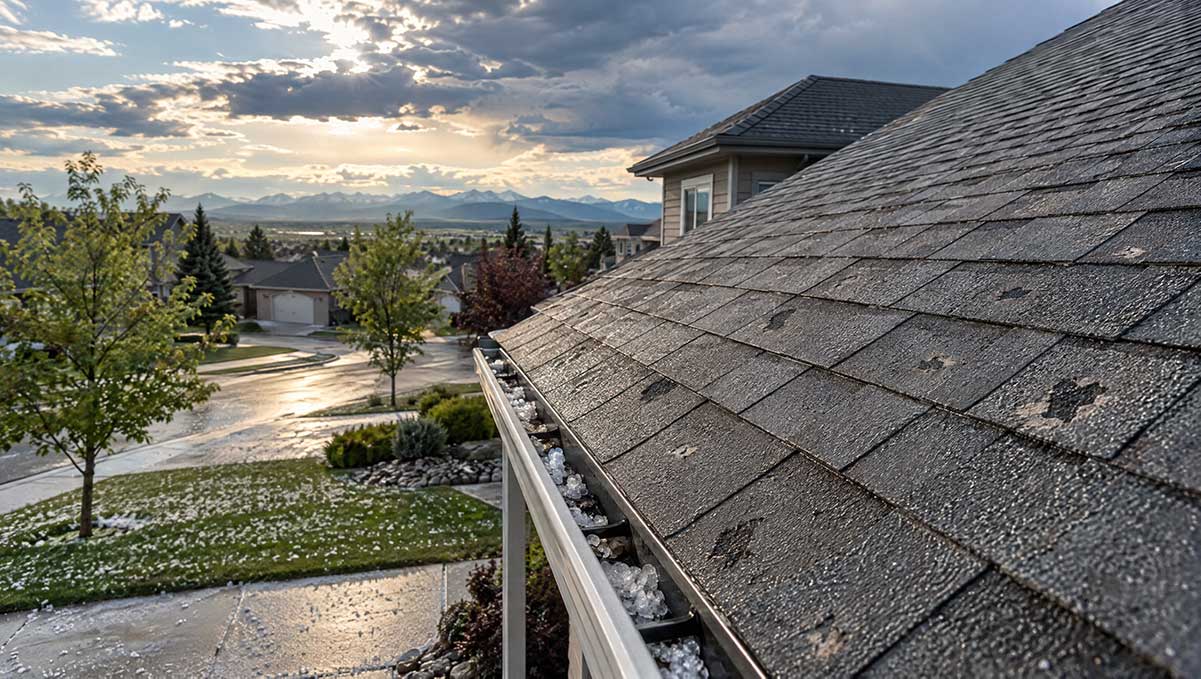
A hailstorm rolls through.
The next morning, you look at your roof and start noticing things you swear weren't there before.
A few dark spots.
Some granules in the gutter.
Maybe a section of shingles looks rougher than you remember.
The answer isn't always obvious.
Hail damage and normal shingle deterioration can look surprisingly similar from the ground. Both can involve granule loss. Both can expose darker asphalt underneath. And an older roof may naturally look worse once you've gone outside specifically looking for damage.
But there are differences.
Hail tends to leave impact-related damage in irregular patterns, while normal aging usually develops more gradually across broader areas of the roof.
Inspectors also look for supporting evidence on vents, flashing, gutters and other exposed surfaces rather than diagnosing hail damage from one suspicious-looking mark.
Hail Damage vs. Normal Aging
The easiest distinction to understand is the pattern.
Aging happens over time. Hail happens in a storm.
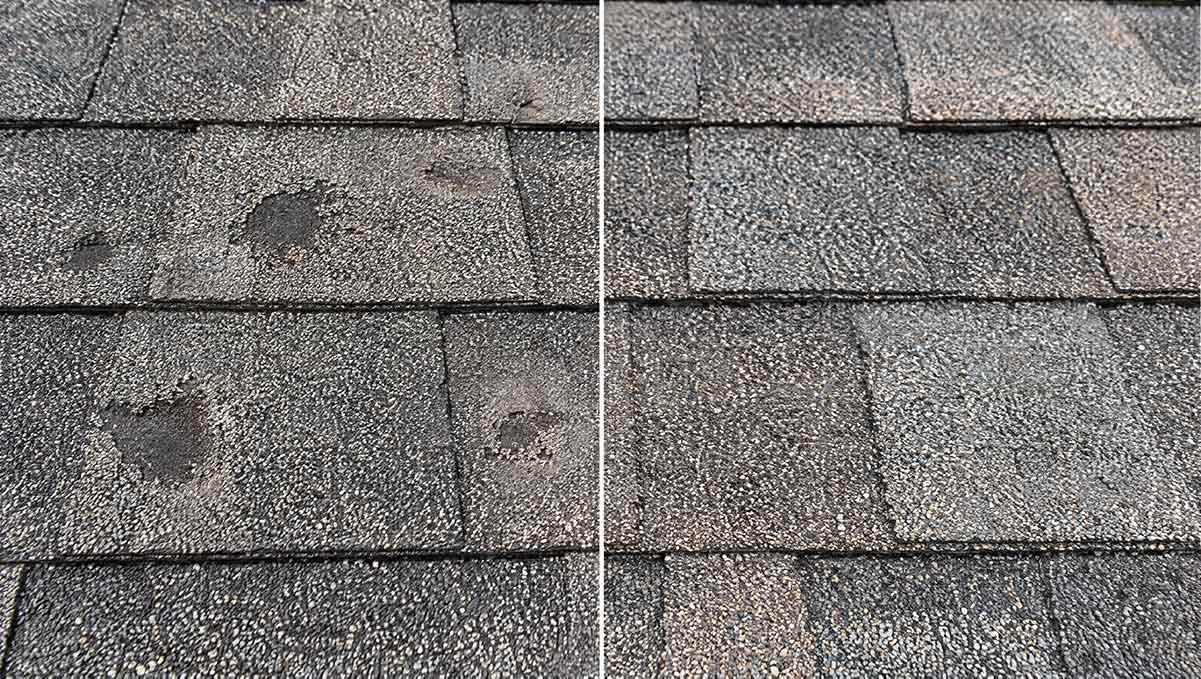
Impact-Driven Damage
Scattered individual impact marks, dents or depressions, localized granule displacement, bruising or cracking that appears after a known storm.
Gradual Deterioration
Broad fading, relatively distributed granule loss, dryness, brittleness, cracking and curling that develop progressively over years.
What Does Hail Damage Actually Look Like on Asphalt Shingles?
There isn't one perfect “hail damage” shape.
Real hailstones vary in size, hardness, shape, speed and angle of impact. A softer hailstone can behave very differently from a hard one even when they're roughly the same diameter.
On a real asphalt roof, hail damage can appear in several ways.
Granule Displacement
A concentrated impact area may knock granules away and expose darker asphalt underneath.
Dents or Depressions
The shingle may show a localized indentation where the hailstone struck the surface.
Cracking or Tearing
More serious impacts can damage the asphalt or reinforcing mat rather than only affecting surface granules.
Sometimes the damage is obvious.
Sometimes it isn't.
A roof can also experience damage that doesn't immediately create a dramatic visible defect or leak, which is why a quick look from the driveway cannot always tell you exactly what happened.
Look at the Pattern, Not Just One Mark
Imagine an asphalt roof that has spent 15 years in Alberta weather.
The colour may have faded. Granules have gradually weathered. Some slopes have taken more sunlight, wind and snow than others.
That deterioration usually develops across broader areas.
Hail is different. A storm throws individual pieces of ice at the roof, so genuine impact damage often appears as scattered locations rather than perfectly uniform wear.
Timing Matters Too
Ask yourself whether the condition genuinely appeared after the storm or whether the hailstorm simply caused you to look closely at a roof you hadn't inspected in years.
On an aging roof, the answer can sometimes be both: normal deterioration was already present, and the storm added new damage on top of it.
Hail Damage vs. Normal Granule Loss
This is where homeowners can get especially confused.
Granule loss happens on asphalt roofs even when there hasn't been a hailstorm.
Granules are the small mineral particles covering the asphalt surface of the shingle. They provide colour and help protect the asphalt underneath from UV exposure.
Some granule loss is expected throughout the life of a roof.
New shingles can shed loose excess granules. Foot traffic can dislodge them. And normal weathering gradually removes granules as shingles age.
Hail can remove granules too.
The difference is often how they're being lost.
Normal age-related loss tends to develop progressively across the shingle surface.
Hail can produce concentrated areas of granule displacement around individual impact locations, sometimes leaving darker asphalt exposed underneath.
So finding granules in your gutter the morning after a storm does not automatically prove the roof suffered meaningful hail damage.
It tells you there are loose granules.
You still need context.
Learn more about roof shingle granule lossWhat Does Normal Roof Wear Look Like?
Normal aging usually isn't dramatic.
An asphalt roof generally doesn't look perfect one afternoon and suddenly look 20 years old the next morning.
The changes accumulate.
Granule Loss & Fading
Granules gradually loosen and colour can fade after years of exposure to sunlight and weather.
Dryness & Brittleness
Asphalt shingles become less flexible as they age and weather, eventually making cracking more likely.
Curling & Edge Wear
Edges may begin to curl or distort as the roofing material gets older, although other roofing-system issues can also cause movement.
Different sections of the roof may also age at different rates depending on sunlight, orientation, ventilation, shade and exposure.
None of those signs automatically mean immediate replacement.
They tell you the roof is aging.
How long do asphalt shingles last in Alberta?What Is a Hail “Bruise” on a Shingle?
You'll often hear roofers use the word bruise when talking about hail damage.
They're describing an area where an impact may have affected more than the visible surface granules.
An impact can deform the shingle, disturb granules or affect the asphalt and reinforcing material underneath.
That underlying damage can matter even when the shingle hasn't been punched clean through.
But this isn't something we'd recommend a homeowner climb onto the roof and start pressing with their thumbs to diagnose.
Apart from the obvious fall risk, walking around on an older roof can itself disturb granules or brittle roofing material.
If the distinction requires physically examining suspected impact areas, let someone who knows what they're looking at do it.
Look Beyond the Shingles
One of the most useful clues after a hailstorm may not be on the shingles at all.
Hail strikes everything exposed to it.
Metal roof vents can dent. Flashing can dent. Gutters and downspouts can show impact marks. Siding, exterior fixtures and other exposed materials may show evidence too.
This matters because a questionable mark on one old shingle isn't much evidence by itself.
A questionable shingle mark plus fresh dents on a metal vent, flashing and gutter after the same storm provides much stronger context.
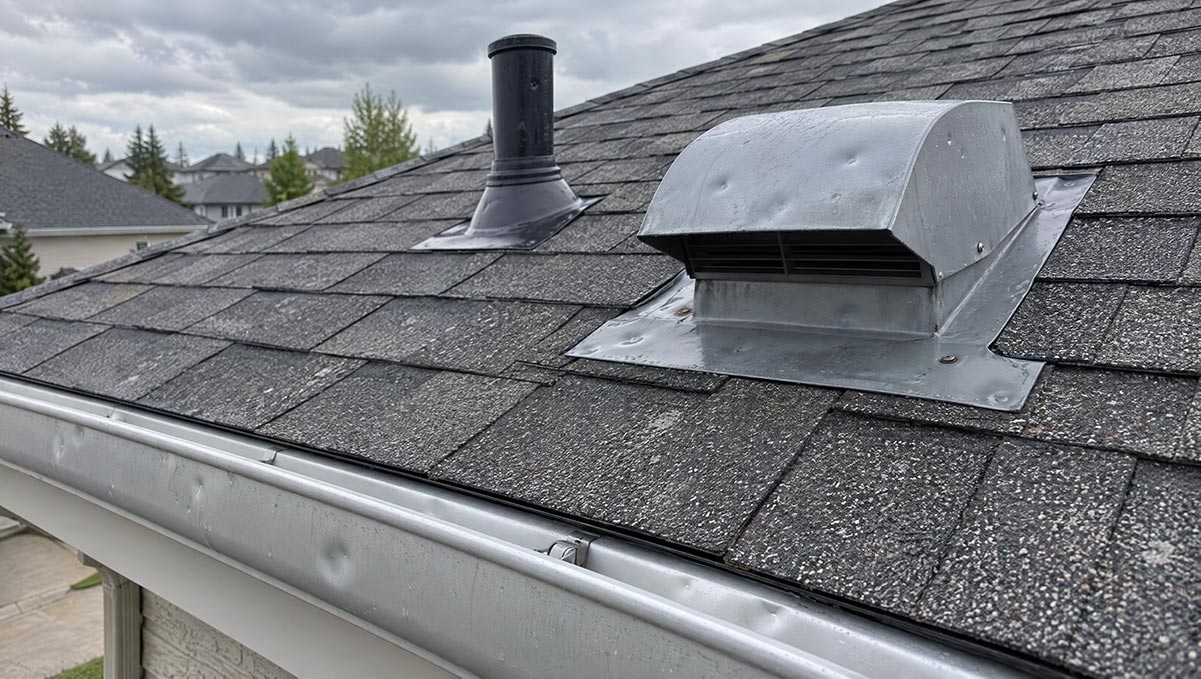
A Dented Roof Vent Doesn't Automatically Mean Your Shingles Are Ruined
Different roofing materials respond to hail differently.
Metal may dent while continuing to function perfectly well.
Asphalt shingles react differently depending on the product, age of the roof and characteristics of the hailstone.
So collateral damage tells us that hail hit the property.
It does not, by itself, tell us exactly what happened to every shingle.
The roof still needs to be evaluated on its own condition.
Why an Older Roof Can Be Harder to Evaluate After Hail
Imagine two identical houses are hit by the same storm.
One roof is two years old.
The other is 17 years old.
We shouldn't automatically expect them to respond in exactly the same way.
Aging changes roofing materials.
Granules may already have been lost. The asphalt has weathered. The roof has spent years exposed to UV, heat, cold and seasonal weather.
A storm may be the event that makes deterioration obvious, but the roof's condition before the storm still matters.
This is also why “there are granules missing” isn't enough information by itself.
Were they lost gradually over 15 years?
Did yesterday's storm knock them away?
Or is it a combination of both?
Sometimes the answer really is both.
Can Hail Damage Cause Problems Later Even If the Roof Isn't Leaking?
Yes.
A roof does not have to leak immediately for storm damage to matter.
Hail can displace protective granules, deform roofing material or cause cracking and other damage without creating an instant leak.
At the same time, a few surface marks do not automatically mean catastrophic damage.
Severity matters.
But it isn't proof that nothing happened.
What About Granules in My Gutters After a Hailstorm?
It's worth noticing.
But don't use gutter granules as your entire diagnosis.
Granules naturally come off asphalt shingles throughout their service life.
An older roof can already be shedding them before a storm arrives.
A hailstorm may accelerate that loss, while heavy rain can wash material that was already loose into the gutters.
It's “Is this noticeably different from what was happening before, and is there corresponding impact evidence on the roof?”
Hail Damage and Wind Damage Are Different Too
Alberta storms don't always arrive carrying one neatly isolated weather hazard.
Strong thunderstorms can bring hail and high winds at the same time.
Wind tends to affect shingles differently.
The inspection needs to separate those things rather than treating every post-storm defect as the same problem.
Can You Identify Hail Damage From the Ground?
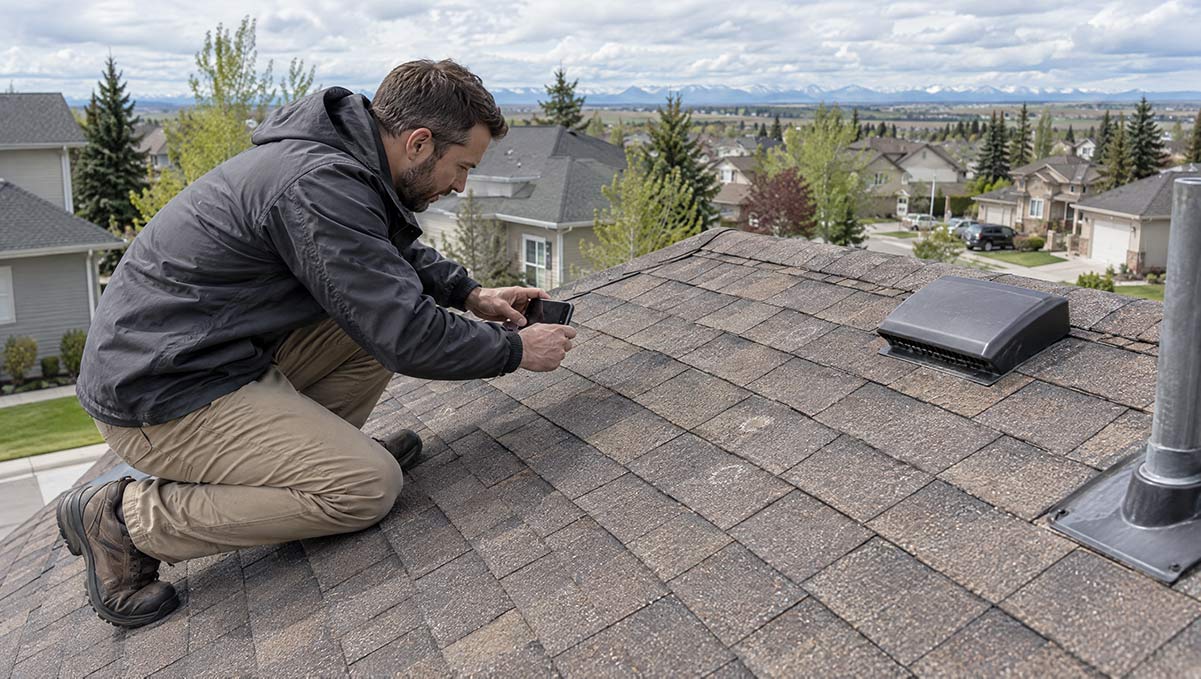
You can identify reasons to investigate from the ground.
That's different from making a final diagnosis.
Look for obvious missing or displaced shingles, changes in roof appearance, damaged gutters or downspouts, dents on exposed metal components and debris around the property.
But many types of asphalt-shingle damage are difficult to evaluate from street level.
So don't climb onto a wet or questionable roof because you're curious.
Take photos of anything you can safely document and have the roof inspected properly if something looks wrong.
What Should You Document After an Alberta Hailstorm?
If you think the property may have been damaged, documenting what happened while it's fresh is sensible.
Photograph the Property
Take wide photos and closer photos of anything you can safely see or reach from the ground.
Record Collateral Damage
Document gutters, downspouts, siding, vehicles, vents and other exposed surfaces that show fresh marks.
Keep the Timing
Note the approximate storm date and time and keep any photos showing unusually large hailstones or storm conditions.
If a roofing professional inspects the roof, ask them to photograph and explain what they're identifying.
If you believe you may have an insurance claim, review your own policy and contact your insurer for its requirements rather than relying entirely on a contractor to interpret your coverage.
Create a record of what happened before repairs, weather or time change the evidence.
Be Careful With the Phrase “You Have Hail Damage”
Hailstorms create an unusual situation for homeowners.
You may not know what roof hail damage looks like.
The contractor does.
And potentially thousands of dollars of work may depend on what they tell you.
That doesn't mean contractors are dishonest.
It means homeowners should ask questions.
If someone points to a mark and calls it hail damage, ask them to explain why.
Is granule loss concentrated around an apparent strike?
Is there damage beneath the surface?
Are similar impacts distributed irregularly across the roof?
Is there supporting evidence on metal components?
A good inspection should be able to explain what you're looking at rather than simply telling you that the roof is damaged.
Can a Hail-Damaged Roof Still Be Rejuvenated?
Potentially—but the hail damage needs to be dealt with first.
Roof rejuvenation is intended to preserve asphalt shingles that are still structurally sound but beginning to show age-related deterioration.
It is not a repair for hail damage.
If shingles have been torn, fractured, punctured or otherwise functionally damaged by a storm, spraying a preservation treatment over those problems doesn't make them disappear.
The roof first needs to be inspected.
Any real storm damage needs to be identified.
Repairable areas need to be repaired.
Only then does it make sense to ask whether the remaining roof is still a good candidate for preservation.
What If the Roof Was Already Aging Before the Hailstorm?
This is a common situation.
Imagine your shingles are 12 or 15 years old.
They're beginning to dry out.
Maybe there is some ordinary granule loss.
But they're still structurally sound.
Then you get a hailstorm.
Did the storm actually damage the roof?
And what condition was the roof in aside from the storm?
Don't blur those together.
If there is legitimate hail damage, deal with it as hail damage.
If the roof survives the storm and remains structurally sound but is showing normal age-related deterioration, preservation may still be worth discussing.
How Alberta's weather actually damages your roofWhen Does Hail Damage Mean the Roof Should Be Replaced?
There isn't one universal amount of visible damage that means every roof must be replaced.
The severity, distribution and type of damage matter.
So does the age and pre-storm condition of the roofing system.
Localized damage may sometimes be repairable.
More extensive tearing, fracturing, widespread impact damage or damage affecting the roof's ability to shed water is a much more serious situation.
The important thing is not to force the roof into a predetermined solution.
Sometimes repair makes sense.
Sometimes replacement makes sense.
Sometimes the inspection determines the roof came through the storm in surprisingly good condition.
And if the real problem turns out to be normal aging rather than meaningful storm damage, preservation may be another option.
Diagnose first. Choose the solution second.
Hail Damage vs. Normal Roof Wear
The easiest way to separate the two is to think about pattern, timing and supporting evidence.
Real roofs aren't laboratory samples. An old roof can be hit by hail, hail can accelerate existing deterioration, and wind and hail can occur together.
That's why there is a limit to what anyone should conclude from one photograph.
Understand the Condition of Your Roof
Why Are My Shingles Losing Granules?
Learn when granule loss is normal aging, when it's concerning and what it can tell you about roof condition.
Read the guideHow Alberta's Weather Damages Your Roof
See how hail, UV, snow, wind and temperature swings affect asphalt shingles over time.
Learn about Alberta weatherHow Long Do Asphalt Shingles Last?
Understand why roof condition matters more than simply counting the years since installation.
Read the lifespan guideFrequently Asked Questions About Hail Damage vs. Normal Roof Wear
What does hail damage look like on asphalt shingles?
Hail damage can appear as dents or depressions, concentrated areas of displaced granules, bruising, cracking or tearing. Genuine damage often appears in scattered impact patterns rather than as uniform deterioration across the entire roof.
How can I tell hail damage from normal granule loss?
Normal granule loss generally develops gradually as shingles weather and age. Hail-related loss is more likely to be concentrated around individual impact areas and may appear alongside dents, cracking or other impact evidence.
Does finding granules in my gutters mean I have hail damage?
No. Asphalt shingles naturally lose some granules over time, and new shingles can also shed excess loose granules. A sudden increase after a storm is worth investigating, but gutter granules alone do not prove hail damage.
Are dark spots on shingles always hail damage?
No. Dark spots can result from normal granule loss, weathering, manufacturing variation, mechanical marks and other causes. Pattern, timing and the physical condition of the shingle all matter.
Does hail damage always look round?
No. Hailstones vary in shape, hardness, size and impact angle. Real impact damage does not always produce a perfect circular mark.
Can hail damage a roof without causing a leak?
Yes. Hail can disturb granules, deform shingles or cause cracking without producing an immediate leak. The absence of a leak today does not automatically mean the roof sustained no damage.
Can small hail damage asphalt shingles?
It can. Damage depends on more than hailstone diameter. Hardness, density, wind, impact angle and the age and condition of the roof all influence how a shingle responds.
Are dents in gutters proof of roof hail damage?
No. They are useful evidence that hail struck the property, but different materials respond differently. The asphalt shingles still need to be assessed independently.
How soon after a hailstorm should I inspect my roof?
You can safely look for visible evidence around the property once the storm has passed and conditions are safe. If you see possible damage or the storm involved significant hail, arranging a professional roof inspection can help determine whether the shingles were affected.
Should I climb onto my roof after a hailstorm?
We don't recommend it. Wet roofing is dangerous, and walking on aging shingles can itself disturb granules or brittle material. Look for clues from the ground and leave close inspection to someone equipped to work safely on the roof.
Can hail damage be repaired instead of replacing the whole roof?
Sometimes. Localized damage may be repairable depending on the affected shingles and the condition of the surrounding roof. Widespread or severe functional damage can make replacement more appropriate.
Can roof rejuvenation fix hail damage?
No. Roof rejuvenation should not be used instead of repairing damaged shingles. Actual hail damage should be identified and addressed first. Rejuvenation may still be worth considering afterward if the remaining roof is structurally sound and qualifies for preservation.
Can an older roof still be rejuvenated after a hailstorm?
Potentially. What matters is whether the storm caused functional damage and what condition the shingles are in after necessary repairs. A roof that remains structurally sound may still be a candidate.
What else should I inspect after a hailstorm?
From the ground, look for visible damage to gutters, downspouts, siding, roof vents, flashing and other exposed surfaces. These can help establish that meaningful hail reached the property, although they do not automatically tell you how badly the shingles were affected.
Not Every Rough-Looking Roof Is Hail Damaged
If you aren't sure whether you're looking at storm damage or normal aging, start with the condition of the roof. Repair real damage when it's there—and preserve a healthy aging roof before it deteriorates too far.
See If Your Roof May Qualify